An end-to-end internal ordering and fulfillment system built with Power Apps, Dataverse, Power Automate, and Power BI.
Project Overview
This project is a capstone-style merch store that supports the full workflow from browsing a catalog to placing orders,
receiving confirmations, and completing admin fulfillment. The solution was designed with a clean separation of roles:
employees place orders through a Canvas app, while admins manage inventory and fulfill requests through a Model-driven app.
The system uses Dataverse as the source of truth and Power Automate to handle notifications, scheduled summaries,
low-stock alerts, and export workflows. Power BI provides reporting for admins and stakeholders.
My Role & Key Contributions
End-to-end solution build: Implemented both the employee ordering experience and the admin fulfillment experience.
Data modeling: Designed the Dataverse schema to support catalog items, orders, order lines, fulfillment, and inventory tracking.
Workflow automation: Built and hardened Power Automate flows for confirmations, admin alerts, summaries, exports, and inventory signals.
Quality & reliability: Added validation and error-handling patterns to reduce failure rates and improve traceability.
Delivery practices: Worked with ALM/SDLC principles (solutions, environments, controlled deployments) and tracked work in Azure DevOps.
Automation layer: Power Automate (notifications, scheduled jobs, exports, inventory alerts)
Reporting layer: Power BI dashboard for analytics and operational insights
Security is role-based, with separate experiences and permissions for employees versus admins.
Data Model (High-Level)
The Dataverse schema was designed to support ordering, inventory, and fulfillment while keeping relationships clean and queryable.
At a high level, the model includes:
Merchandise: catalog items and variants (e.g., size, color)
Orders: order header details (requestor, totals, status)
Order Lines: item-level breakdown per order (qty, price, variant)
Inventory: stock tracking aligned to item variants
Users/Roles: role-based access patterns for employees and admins
Results & Success Metrics
The project was built to meet clear operational targets for speed and reliability:
Order placement: under 2 minutes end-to-end
Admin fulfillment: update inventory and fulfill an order in under 60 seconds
Email delivery: confirmation/alerts delivered within 1 minute
Flow reliability: target under 1% failed runs per month
Project Gallery
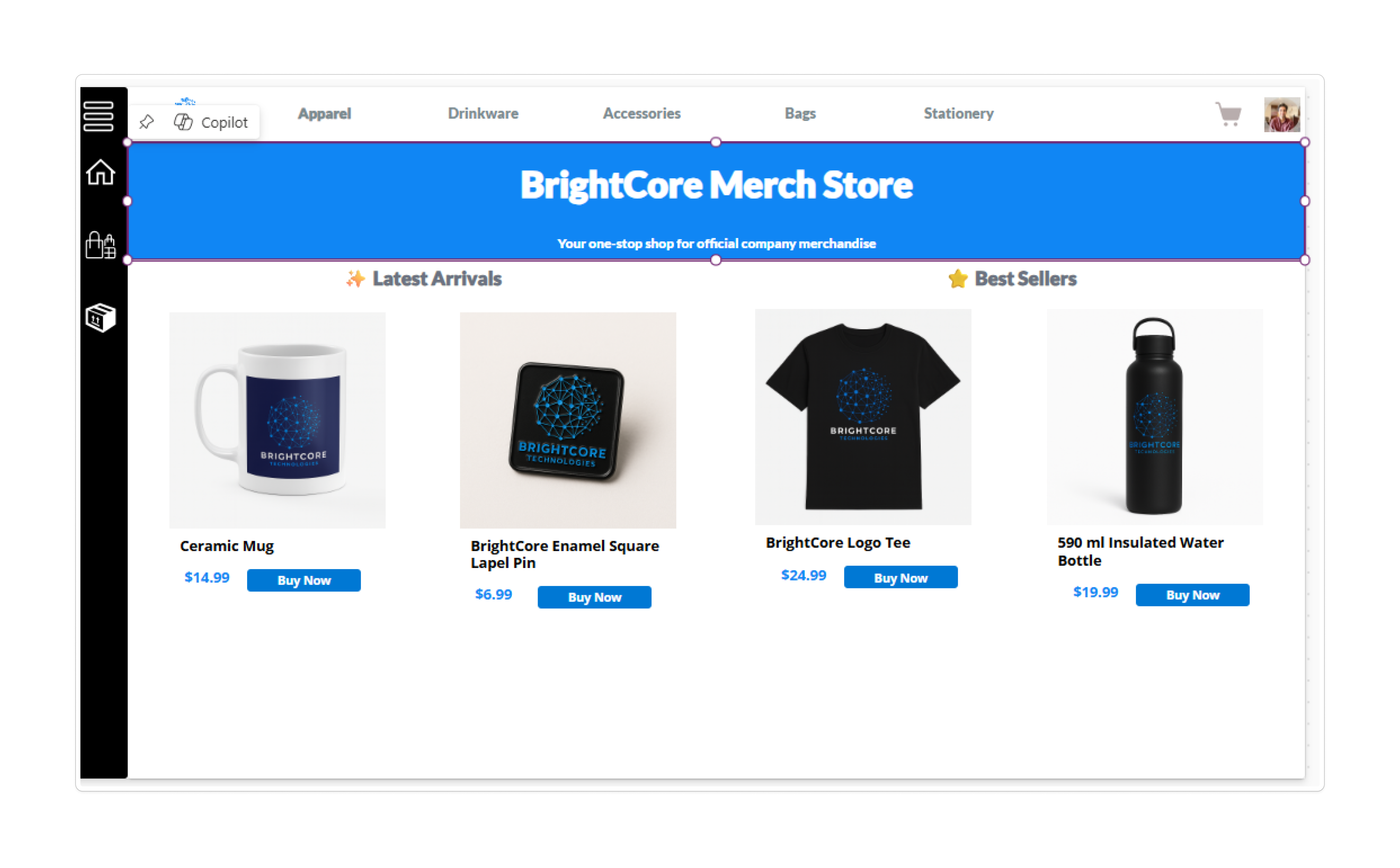
Screens from the employee ordering experience (catalog and checkout).
Catalog view with categories, featured items, and quick purchase actions.Checkout experience with item quantities, totals, and order submission.
Challenges & Learnings
End-to-end integrity: Ensuring orders, order lines, inventory updates, and notifications stayed consistent.
Approach: structured validation, clear status transitions, and defensive flow logic.
Role separation: Designing a smooth employee UX while keeping admin controls powerful and secure.
Approach: role-based experiences (Canvas vs Model-driven) and permission-driven access.
Automation reliability: Minimizing failed flows and ensuring administrators can troubleshoot quickly.
Approach: error handling patterns, logging/tracing where appropriate, and repeatable test scenarios.
Next Improvements
Add approvals for larger orders and role-based limits
Expand analytics (items by department, fulfillment SLAs)